Is National Board For You?

Pre-session Survey

  • Ask me a question with Google Forms
    • What would you like to learn from this workshop?

TPEP (Danielson format) Survey (Optional)

Post-session Survey

What is involved in pursuing National Board certification?

  • Scott shares his story about successfully completing the process in 2014 for the Career and Technical Education certification

The NB Process

Preparation

Feedback = Learning

Feedback is needed to improve. Examine methods to increase the frequency and quality of feedback with students. Many examples of online and paper-based forms and techniques will be shared. New and improved distance learning edition!

Contribute to the Pre-session and TPEP Survey

  • Take the Presentation / Session TPEP Prioritization Agenda Survey
    • This is a standards-based presentation/session
    • Gathering data from students/teachers can help you prioritize the most engaging content
  • Scott placed the TPEP standards which are based on the Danielson Model in a Google Form
    1. What would you like to learn from this session?
    2. What domains and components (Standards) would you like highlighted through this session?
    3. Data gathering is essential for tracking growth, help Scott differentiate the experience to your needs

Review Participant Data To Set Session Goals

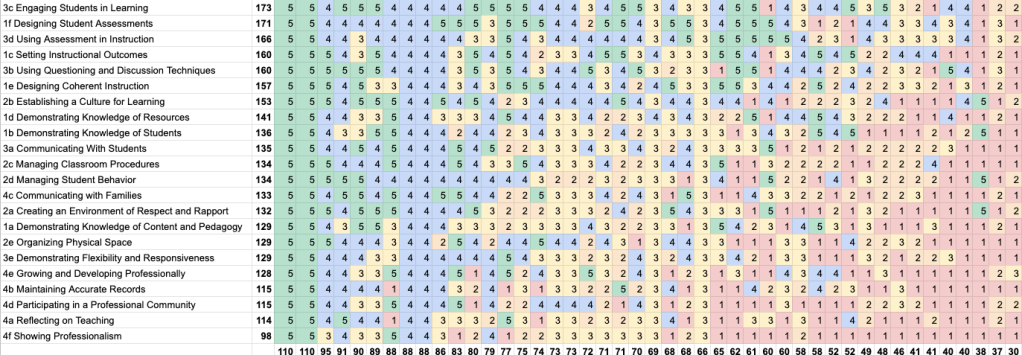
Top TPEP Requested Component…

  • #1 is… 3c Engaging Student Learners (Danielson description PDF), example student behaviors below:
    • Students take the initiative to improve the lesson by (1) modifying a learning task to make it more meaningful or relevant to their needs, (2) suggesting modifications to the grouping patterns used, and/or (3) suggesting modifications or additions to the materials being used.
    • Students have an opportunity for reflection and closure on the lesson to consolidate their understanding.
    • Students are asked to write an essay in the style of Hemmingway and to describe which aspects of his style they have incorporated.
    • Students determine which of several tools—e.g., a protractor, spreadsheet, or graphing calculator—would be most suitable to solve a math problem.
    • A student asks whether they might remain in their small groups to complete another section of the activity, rather than work independently.
    • Students identify or create their own learning materials.
    • Students summarize their learning from the lesson.

Post to Our Session Parking Lot

  • A Padlet parking lot is a great place for students/teachers to post ideas asynchronously
  • This Workshop’s Parking Lot link: https://bit.ly/PadletParkingLot
  • This Workshop’s Parking Lot QR Code: (Padlet generates one automatically)
Padlet QR Code
Session Padlet Parkinglot QR Code

Play Bingo – sort of…

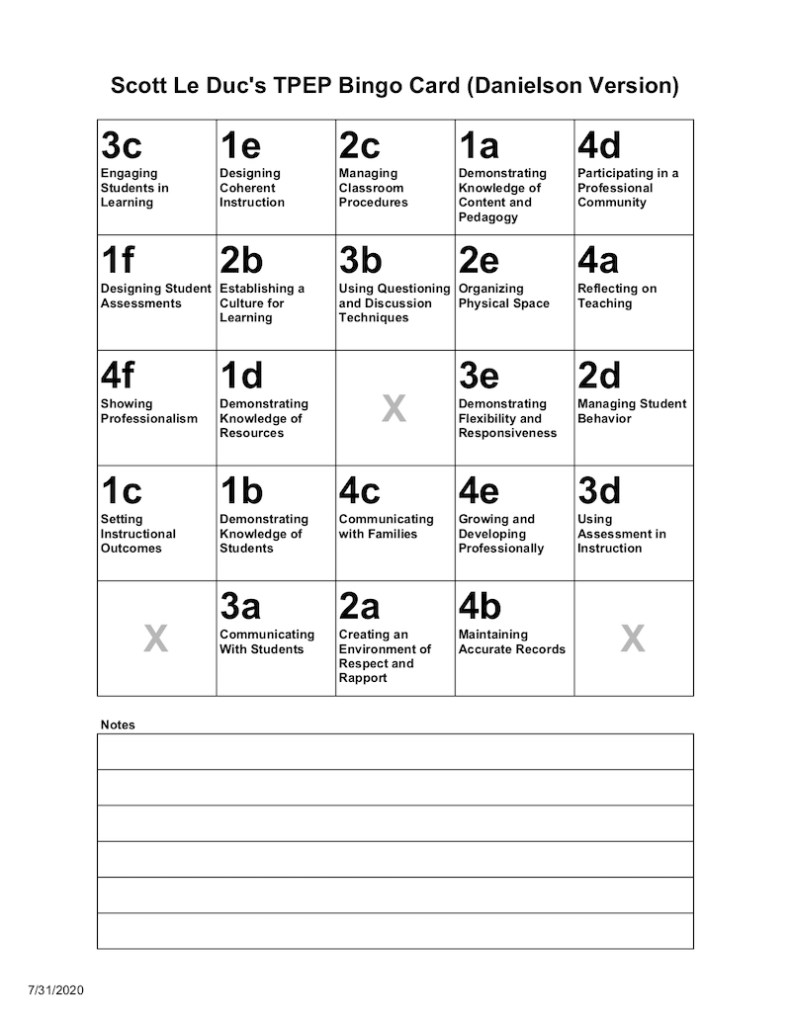
Creative Commons TPEP Bingo Card created by Scott Le Duc

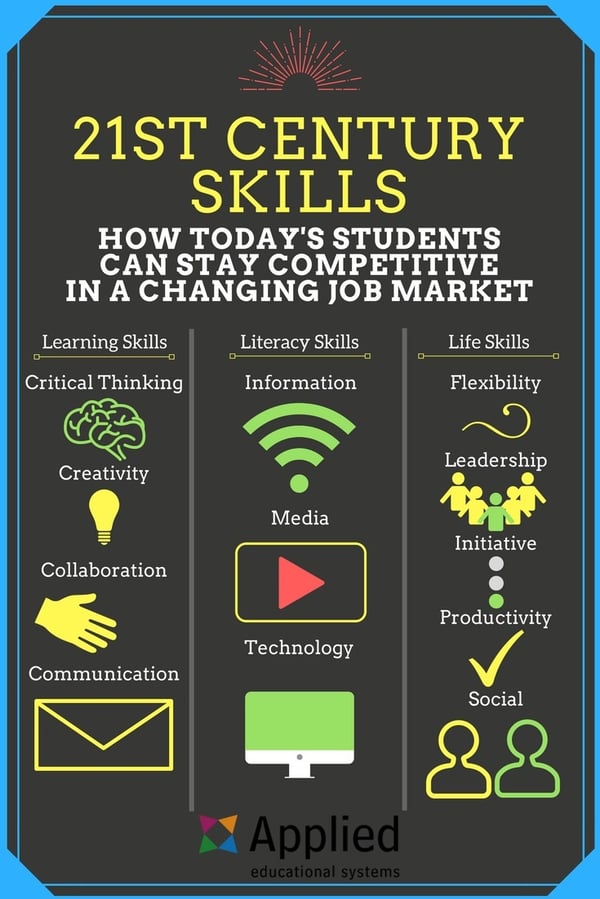
Contribute to the 21st Century Skills Treasure Hunt

Endure Scott Le Duc’s Introduction

  • Decide whether he is credible, or not
    • Started teaching CTE Arts and Technology in 1996 at Capital High School in Olympia, WA
    • Achieved National Board Certification in CTE (2014)
    • Selected as one of the top presenters at numerous CTE conferences
      • He stuffed the ballot box! – shhh…
    • Can moonwalk and touch his tongue to his nose
    • Known to be a nice guy, occasionally

Contemplate Scott’s Presentation Goal

Designed with Andragogy for the ADULT Mind

  1. Need to know: Adults need to know the reason for learning something.
  2. Foundation: Experience (including error) provides the basis for learning activities.
  3. Self-concept: Adults need to be responsible for their decisions on education; involvement in the planning and evaluation of their instruction.
  4. Readiness: Adults are most interested in learning subjects having immediate relevance to their work and/or personal lives.
  5. Orientation: Adult learning is problem-centered rather than content-oriented.
  6. Motivation: Adults respond better to internal versus external motivators.

Remember, Andragogy can be for Young ADULT Mind’s, too!

CC image Student girl by verkeorg at Flickr

Infused with Bloom’s Taxonomy Verbs

CC Image from https://www.fractuslearning.com/blooms-taxonomy-verbs-free-chart/
  1. REDO – No evidence of standard
  2. LIST the stages and procedures used in the recording process. APPROACHING STANDARD
  3. DESCRIBE the stages and procedures used in the recording process. MEETS STANDARD
  4. DEMONSTRATE the stages and procedures used in the recording process. EXCEEDS STANDARD

Example of a Bloom verbs-based rubric where the ‘standard verb’ was ‘describe’ with the lower level verb was ‘list’ and higher level verb was ‘demonstrate’

Contemplate That The Brain Can Only Absorb What The Butt Can Endure

CC image by Scott Le Duc

Contact Scott for Information, Resources, and Training

Get On With It!

Why?

#1 is… 3c Engaging Student Learners (Danielson description PDF), example student behaviors below:

  • Students take the initiative to improve the lesson by (1) modifying a learning task to make it more meaningful or relevant to their needs, (2) suggesting modifications to the grouping patterns used, and/or (3) suggesting modifications or additions to the materials being used.
  • Students have an opportunity for reflection and closure on the lesson to consolidate their understanding.
  • Students are asked to write an essay in the style of Hemmingway and to describe which aspects of his style they have incorporated.
  • Students determine which of several tools—e.g., a protractor, spreadsheet, or graphing calculator—would be most suitable to solve a math problem.
  • A student asks whether they might remain in their small groups to complete another section of the activity, rather than work independently.
  • Students identify or create their own learning materials.
  • Students summarize their learning from the lesson.

What?

  • Quality comes from a system

How?

Building a Quality CTE System with Verbs!

Download a PDF version of the Design for Quality Feedback document

1. Identify Standards

2. Group Concept

  • Batch together complimentary skills

3. Build Units by Verbs

4. Sequence Units

  • What skills sequence well for building a diverse skill base for problem solving and creating?

5. Decide on Outcomes

6. Establish Quality – Skills Checklists

7. Establish Quality – Rubrics

8. Apply Quality

  • Decide what rubrics to use for each unit
    • Be careful to only assess the quality that is directly related to your standards
    • Less is more

9. Construct Project Feedback Process

10. Establish Portfolios

Final Thoughts

Assessments That Grade Themselves

Presented by Scott Le Duc

Can this be true, assessments that are automatically scored and the results emailed to students with support material to help them? Yes, and it’s not the steep learning curve that some may anticipated.

Pre-session Survey

  • Ask me a question with Google Forms
    • What would you like to learn from this workshop?

TPEP (Danielson format) Survey (Optional)

Post-session Survey

Introduction

Ideas and Resources

  • Terms and Concepts vs. Hands On Work – 1 Minute
    • Thinking = Know terms
    • Doing = Understand skills
  • Creating Online Assessments
  • Students Creating Assessments

Battle For The Net

Traffic on 2nd Avenue by Oran Viriyincy (CC)

If you woke up tomorrow, and your internet looked like this, what would you do?

Imagine all your favorite websites taking forever to load, while you get annoying notifications from your ISP suggesting you switch to one of their approved “Fast Lane” sites.

Think about what we would lose: all the weird, alternative, interesting, and enlightening stuff that makes the Internet so much cooler than mainstream Cable TV. What if the only news sites you could reliably connect to were the ones that had deals with companies like Comcast and Verizon?

On September 10th, just a few days before the FCC’s comment deadline, public interest organizations are issuing an open, international call for websites and internet users to unite for an “Internet Slowdown” to show the world what the web would be like if Team Cable gets their way and trashes net neutrality. Net neutrality is hard to explain, so our hope is that this action will help SHOW the world what’s really at stake if we lose the open Internet.

If you’ve got a website, blog or tumblr, get the code to join the #InternetSlowdown here: https://battleforthenet.com/sept10th

Everyone else, here’s a quick list of things you can do to help spread the word about the slowdown: http://tumblr.fightforthefuture.org/post/96020972118/be-a-part-of-the-great-internet-slowdown

Get creative! Don’t let us tell you what to do. See you on the net September 10th!

via Battle For The Net.

Differentiated Instruction with Technology

Pre-session Survey

  • Ask me a question with Google Forms
    • What would you like to learn from this workshop?

TPEP (Danielson format) Survey (Optional)

Post-session Survey

Getting Kids Excited About Learning

PRESENTER

  • Scott Le Duc

OVERVIEW

  • Implementing strategies to successfully engage student learning involves many crucial, interconnected components.  This workshop with offer information and opportunities to experience concepts and tools that connect students interests to curriculum goals, assess learning quickly and efficiently, adapt activities to the student’s readiness to learn, and reinforcing knowledge retention.
RESOURCES

SCHEDULE 8:00 – 8:45 Getting to Know You Concept

  • What areas of Danielson would you like to see examples of evidence and artifacts?
  • Gather previous DI background from participants
  • Gather input from group about what they want from the training
  • This information will help structure the day

Tools

DI Assessment Concept

  • Knowledge of Students / Prior knowledge

Tools

  • Online YuGiOh Personality Cards
  • Online Multiple Intelligences and Learning Styles Quizzes
  • Kagan Small Teams

Concept

  • Pre-assessment / Prior Knowledge

Tools

8:45 BREAK 9:00 – 10:15 DI Assessment Cont. Concept

  • Student Work in Portfolios, Feedback, Feedback Forms, and Exit Cards

Tools

Concept

  • Standards-based Grading and Competency Sheets

Tools

10:15 BREAK 10:30 – 11:30 Low-Prep, High-Impact Strategies, Activities & Materials Concept

  • Research, Planning, Organization, and Storyboarding

Tools

Concept

  • Presentation (Not the way you probably expect!)

Tools

Concept

  • I do. We do. You do. and Question Answer Relationship (Q.A.R.)

Tools

11:30 – 12:30 LUNCH 12:30 – 1:15 Tiered Assignments Concept

  • Standards, Complexity of Activities, and Readiness

Tools

1:15 BREAK Tiered Assignments Cont. 1:30 – 2:30 Tiered Assignments – Cont. Concept

  • Product Possibilities

Tools

2:30- 3:00 Managing the Differentiated Classroom, Exit Cards & Summaries Concept

  • Non-Cognitive Skills and Student Success

Tool

Concept

  • Routines, Rituals, Anchor Activities, and Student Groups

Tools